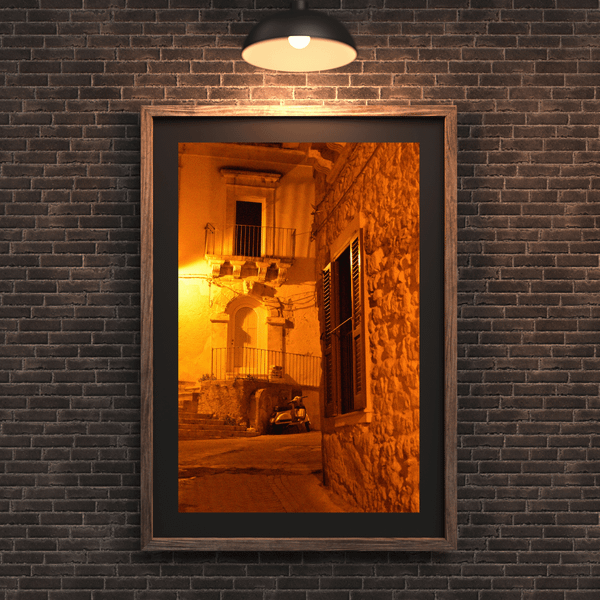
The Plaka Street-by-Street Guide
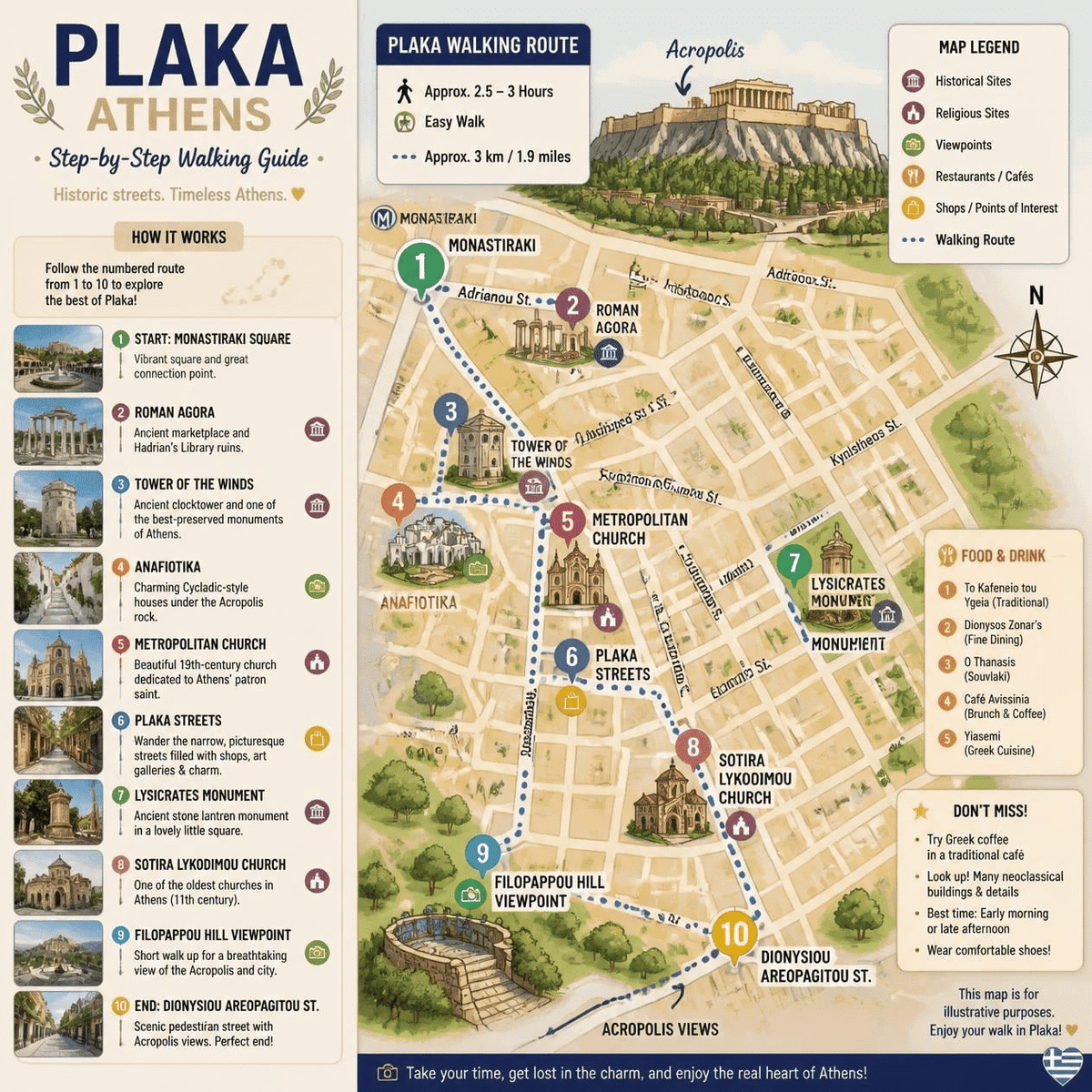
A self-guided walk through the stories of Athens' historic neighbourhood
Plaka is one of the places in Athens where the city's layers come together. Ancient ruins, Byzantine churches, neoclassical houses, quiet courtyards and narrow streets sit side by side beneath the Acropolis.
This guide takes you through 13 streets and the places worth noticing along the way — the landmarks, details and stories that are easy to miss when you're simply passing through.
Start at Acropolis Station, follow the route at your own pace, and let the streets reveal themselves one by one.
Use the map below to follow the walk. Each stop opens a small window into the history and character of the place you're standing in.
Table of Contents
- Acropolis Metro Station
- Thrasylloy Street
- Stratonos Street
- Anafiotika
- Plaka Proper
- Tripodon Street
- Lysikratous Street
- Kydathineon Street
- Filomousou Etairias Square
- Adrianou Street
- Roman Agora
- Hadrian's Library
- Ancient Agora
- Monastiraki Square
→ Start
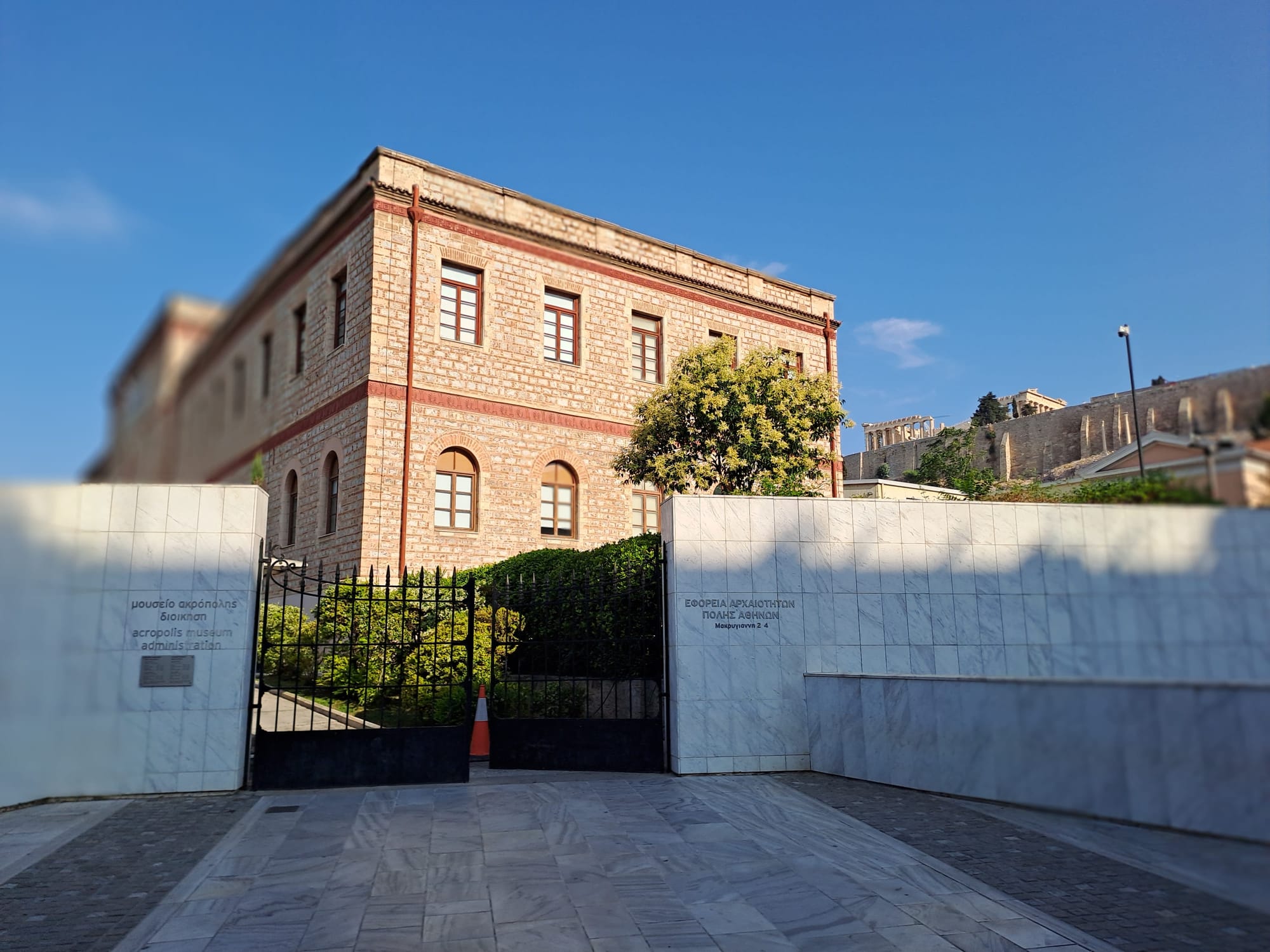
01 — Acropolis Metro Station
Where ancient Athens meets the modern city
Your walk begins beneath the Acropolis, at Acropolis Metro Station — one of the most remarkable gateways into Athens.
As you emerge from the station, look around before heading anywhere. Within a few steps, the modern city gives way to layers of history: the Acropolis rises above you, archaeological remains appear beneath your feet, and the streets begin to narrow as you approach Plaka.
Look around
The Acropolis Museum
Just across the street, the museum's glass architecture offers a striking contrast to the ancient monuments above. Look down as well as up — sections of the archaeological site are visible beneath the museum through its glass floor.
Dionysiou Areopagitou
From here, head towards the pedestrian promenade that follows the southern slope of the Acropolis. It is one of Athens' most atmospheric walks, passing ancient monuments, street musicians and views towards the Acropolis.
The Parthenon above you
Before continuing, look up. The Acropolis dominates the skyline here, but its appearance changes as you move through the neighbourhood. Keep watching it as you walk — you'll encounter it from very different perspectives throughout the route.
📖 A gateway between two Athens
The area around the station is more than simply a starting point. It marks a transition between modern Athens and the archaeological heart of the city.
Beneath today's streets lie traces of ancient life, while the neighbourhood around you has been continuously reshaped over centuries. Within a short walk, you will move from major archaeological sites into the much smaller scale of Plaka — narrow streets, old houses, churches, courtyards and everyday Athenian life.
Take your time here. The walk has begun.
From the station, make your way towards Dionysiou Areopagitou and then turn into the quieter streets leading towards Plaka. Your next stop is Thrasyllou Street, where ancient monuments and later layers of Athens begin to appear side by side.
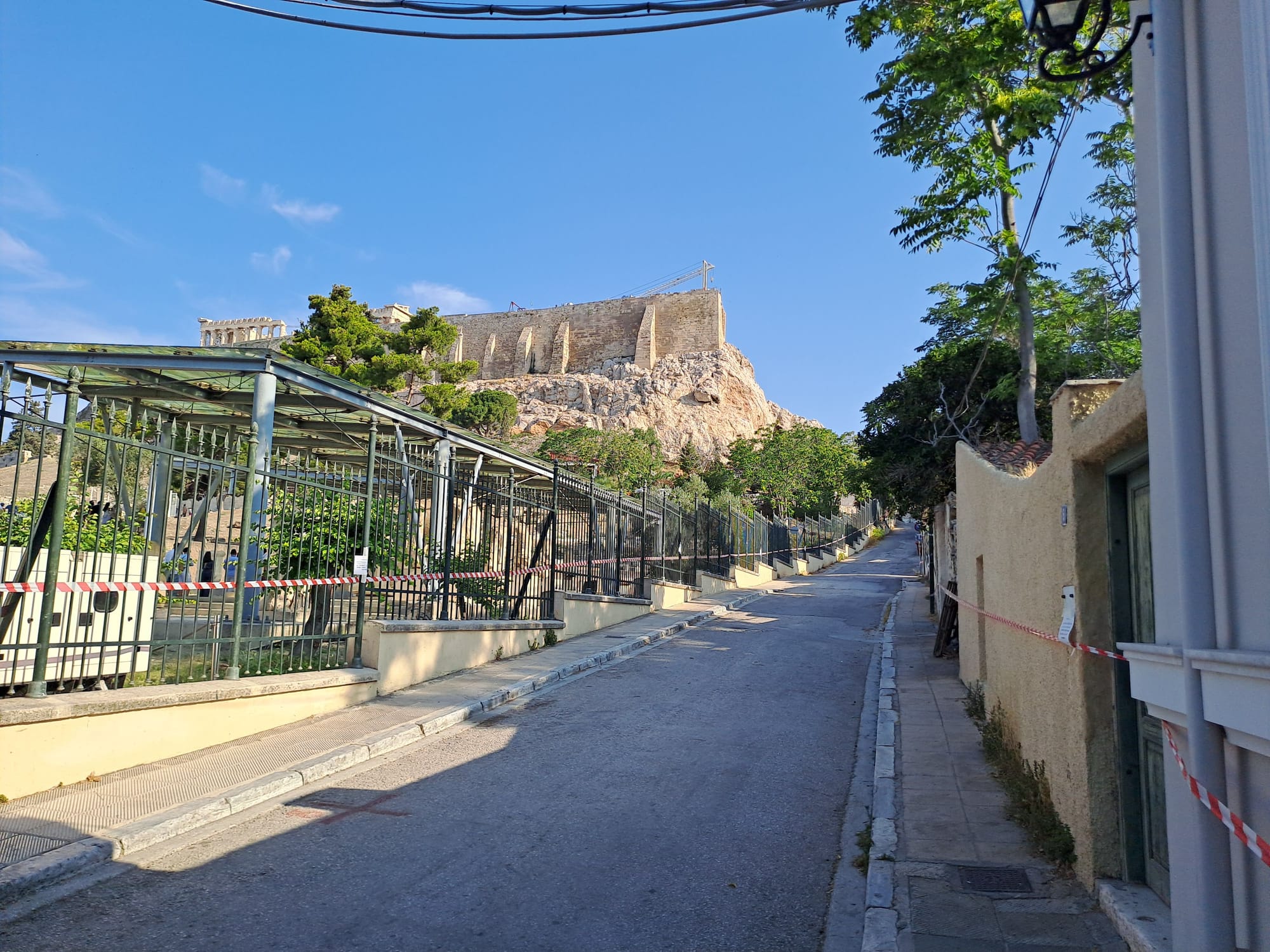
02 — Thrasyllou Street
Where ancient Athens and later life meet
As you leave the bustle around the Acropolis and turn into Thrasyllou Street, the atmosphere changes almost immediately. The street feels quieter and more residential, but look closely and you'll find that its walls and surroundings carry traces of very different periods of Athens.
This is one of those Plaka streets where history isn't confined to a museum — it is part of the everyday landscape.
👀 Look around
The Choregic Monument of Thrasyllos
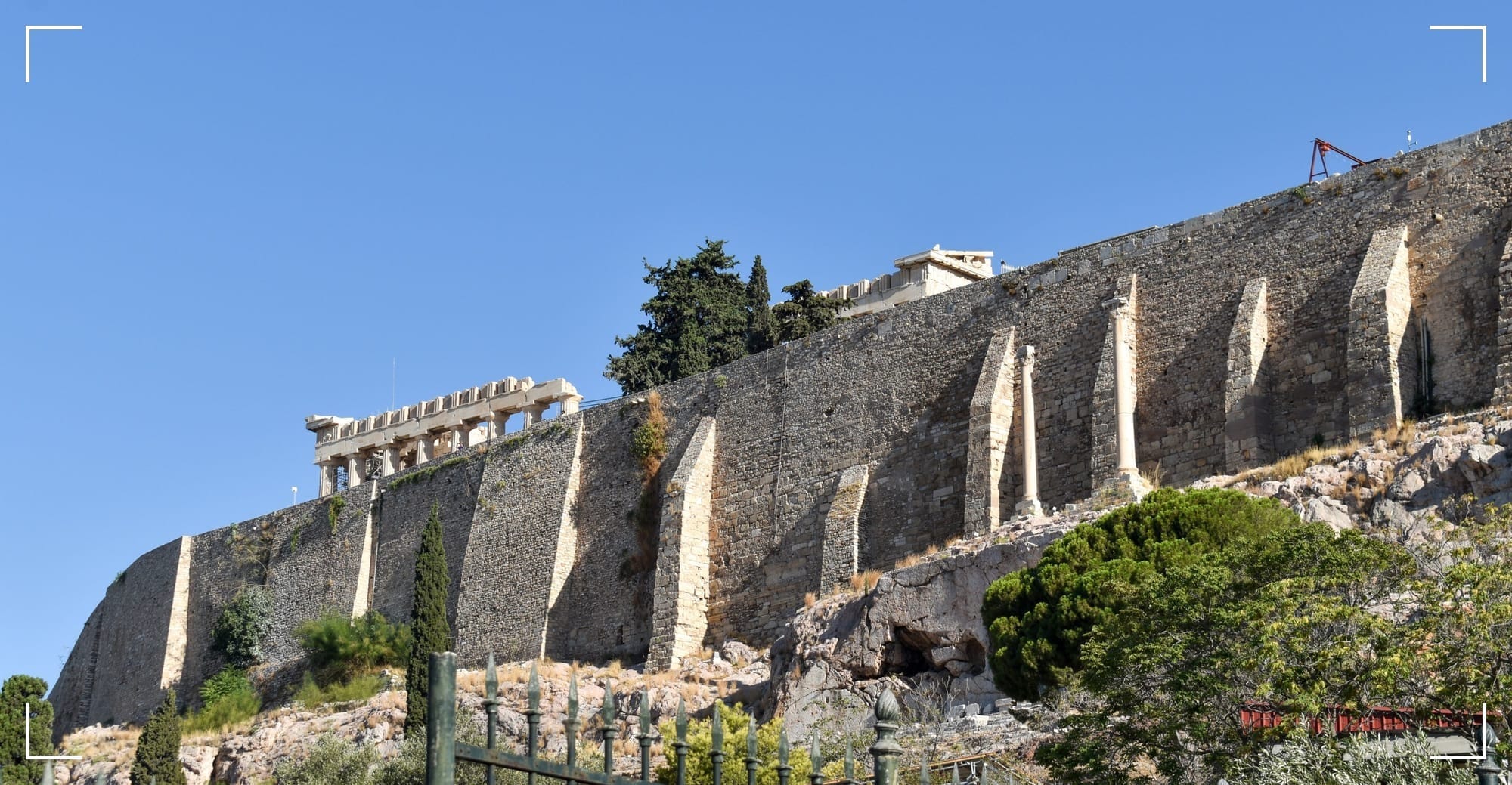
Look towards the rock of the Acropolis for the remains of this ancient monument, originally erected in the 4th century BCE by Thrasyllos to commemorate a theatrical victory.
Centuries later, a small Byzantine chapel was incorporated into the monument. Known as Panagia Spiliotissa, it gives the site its unusual combination of ancient and Christian history.
The remains of the Odeon of Pericles
The area also connects with the remains of the ancient Odeon of Pericles, once associated with musical and theatrical performances near the Theatre of Dionysus.
The conservation work of modern Athens
Nearby is the Ephorate of Prehistoric and Classical Antiquities, where archaeological finds are studied and conserved. You may not be able to see the work taking place, but its presence is a useful reminder that Athens' ancient history is still being actively uncovered, documented and preserved.
📖 A street of layers
Thrasyllou Street is easy to pass through without stopping. But this is precisely what makes it worth slowing down.
An ancient theatrical monument. A Byzantine chapel. Archaeological remains. Modern conservation work. Ordinary homes.
They all occupy the same small corner of the city.
Athens doesn't always reveal its history through grand monuments. Sometimes you find it in the layers between them.
← Previous stop | Top | Next stop →
Continue towards Stratónos Street, following the slope of the Acropolis. The character of the neighbourhood gradually changes again as you approach the entrance to Anafiotika.
03 — Stratonos Street
The quiet edge of Anafiotika
Stratónos Street curves along the northeastern slope of the Acropolis, where Plaka begins to give way to the tiny, whitewashed world of Anafiotika.
It is a short and relatively quiet stretch, but one that rewards you for looking closely. Here, the scale of the city suddenly changes — from archaeological monuments and busy pedestrian routes to small houses, stone walls and narrow passages climbing the rock.
👀 Look around
St. George of the Rock
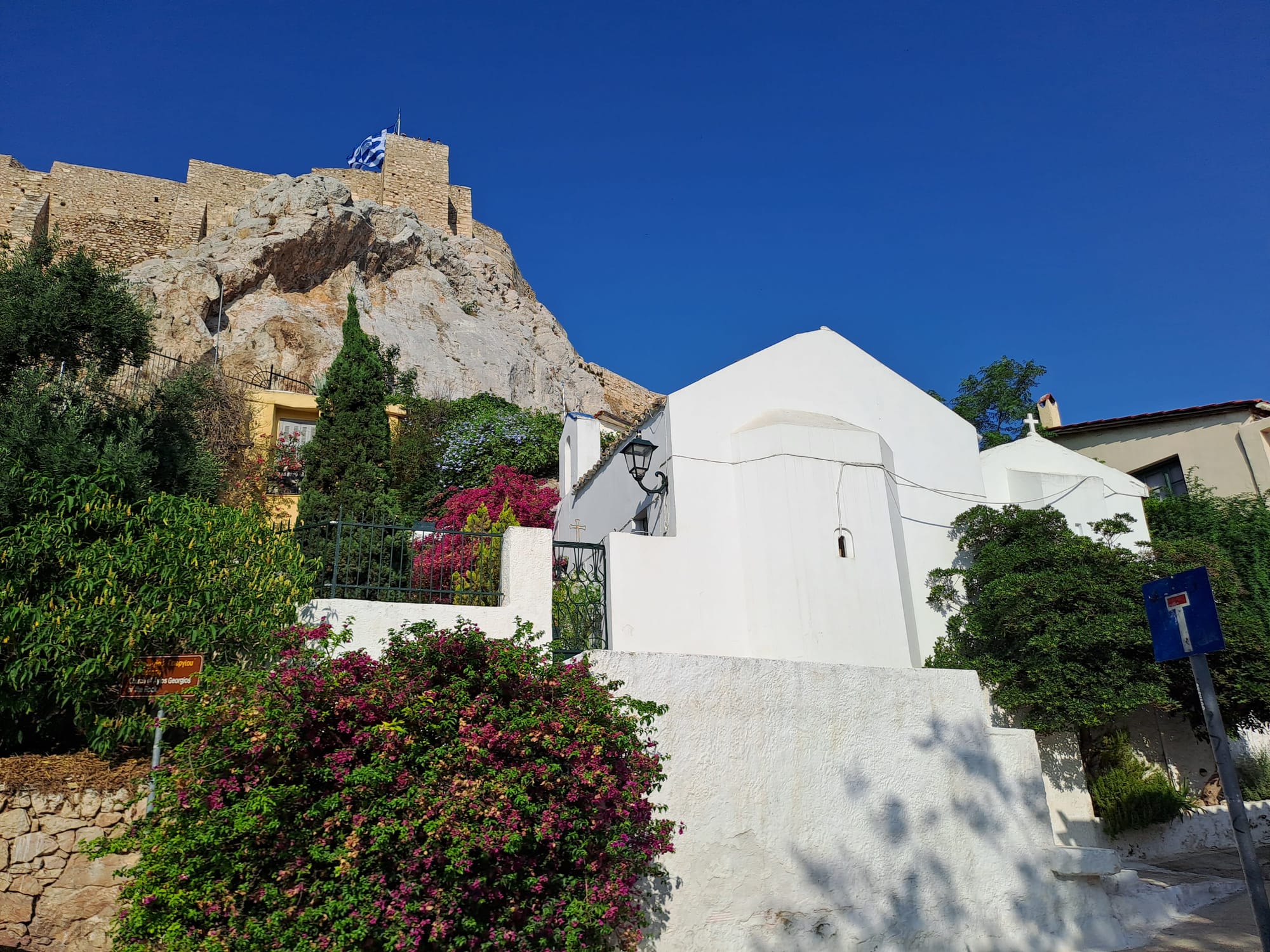
Look for the small Byzantine church of Agios Georgios tou Vrachou — St. George of the Rock. Built against the Acropolis slope, the church takes its name from its setting among the rocks.
It also marks one of the entrances into Anafiotika.
The neoclassical houses
Along the street, notice the surviving neoclassical buildings with their shutters, balconies and carefully proportioned façades. They belong to a very different period of Athens' history, when the city was being transformed into the capital of the newly established Greek state.
Anafiotika begins here
Look beyond the main street and you'll begin to see the distinctive whitewashed walls and tiny passages of Anafiotika.
The neighbourhood was built in the 19th century by craftsmen from the Cycladic island of Anafi, who came to Athens to work on the construction of the new capital.
📖 From the Acropolis to the Cyclades
There is something almost surprising about reaching Anafiotika from this direction.
You have been walking through the archaeological landscape of ancient Athens, yet suddenly the architecture begins to resemble a tiny Cycladic village.
That contrast is part of what makes this corner of Plaka special. Ancient Athens, 19th-century Athens and the memory of a Cycladic island all meet within a few steps of one another.
Take a moment before continuing. The streets are about to become narrower, quieter and much more intimate.
← Previous stop | Top | Next stop →
From Stratónos Street, follow the signs and narrow passages towards Anafiotika. Let yourself wander briefly through its whitewashed lanes before continuing deeper into Plaka.
04 — Anafiotika
A Cycladic village beneath the Acropolis
Entering Anafiotika feels like stepping into another part of Greece without leaving Athens.
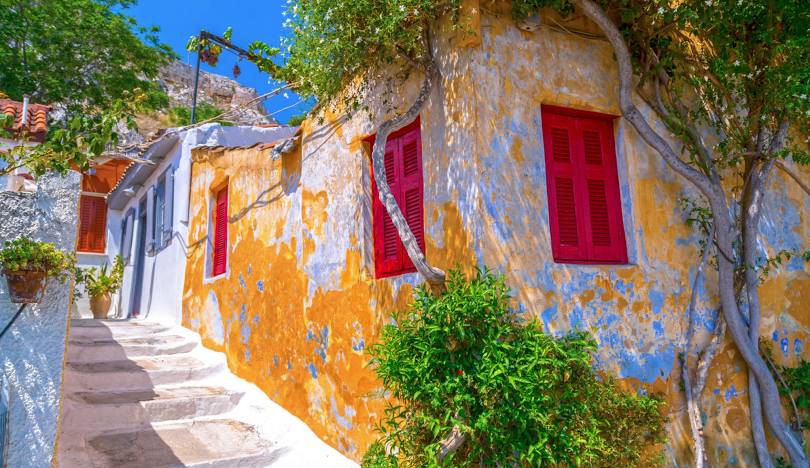
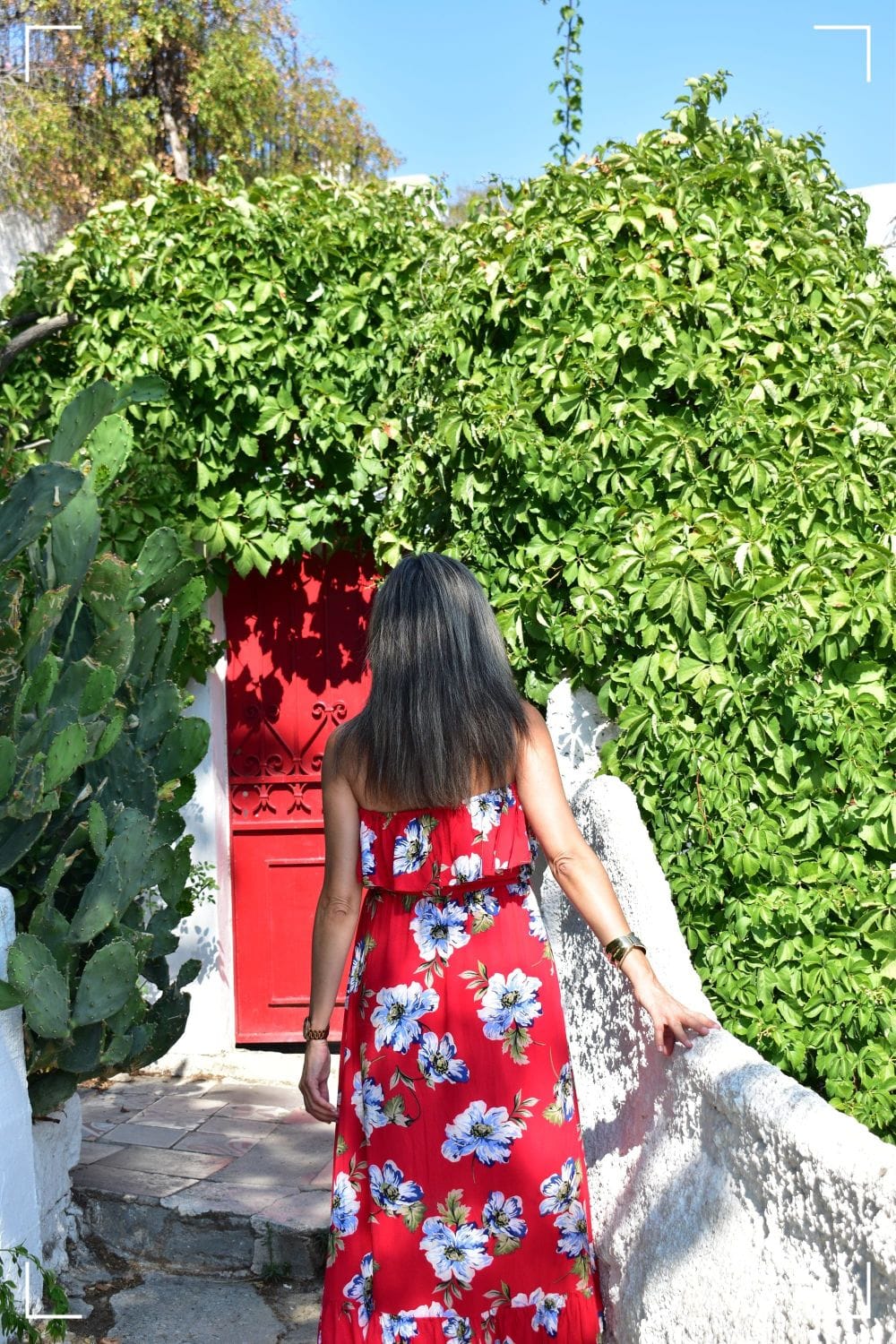
Whitewashed walls, tiny houses, narrow steps and irregular passages climb the northern slope of the Acropolis. The neighbourhood is small, intimate and deliberately different from the grand scale of the monuments surrounding it.
👀 Look around
The narrow lanes
There is rarely a straight line here. Follow the steps and passages as they wind between houses, walls and small courtyards. Some paths feel almost too narrow to be streets at all.
The whitewashed houses
Look closely at the simplicity of the architecture — white walls, blue details, small windows and flowers spilling from pots. The Cycladic character isn't accidental.
The Acropolis above
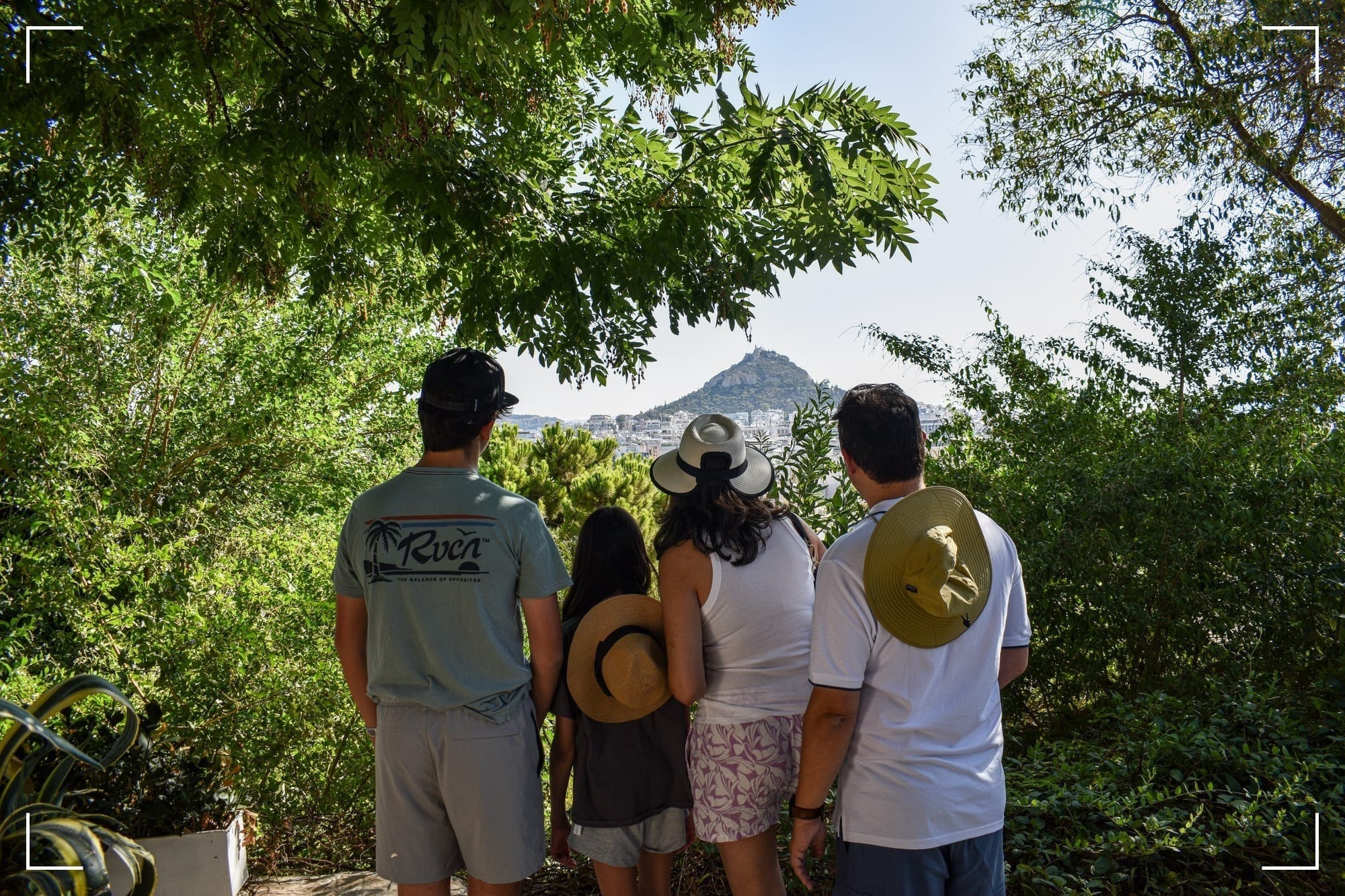
Keep looking back and up. From inside Anafiotika, the Acropolis appears from unexpected angles, sometimes framed tightly between houses and walls.
📖 A village built for craftsmen
Anafiotika was created in the 19th century by builders and craftsmen from the island of Anafi, who came to Athens to work on the construction of the new capital.
They built homes in the architectural language they knew from their island: small, whitewashed structures adapted to the steep terrain.
Over time, much of the original neighbourhood disappeared, but a small section survived on the Acropolis slope.
What remains today is one of Athens' most distinctive neighbourhoods — a piece of the Cyclades tucked into the heart of the capital.
🚶 Take your time
Anafiotika isn't a place to rush through.
Rather than following a strict route, allow yourself a few minutes to explore its little passages. Some lead nowhere, others reveal unexpected views over Athens.
Just remember that this is still a residential neighbourhood. Walk quietly, respect private spaces and resist the temptation to treat every doorway as a photo opportunity.
← Previous stop | Top | Next stop →
When you're ready, make your way back towards the lower part of Anafiotika and continue downhill into Plaka proper, where the scale of the streets begins to open up again.
05 — Plaka Proper
The heart of the old neighbourhood
Leaving the narrow passages of Anafiotika, Plaka opens up again.
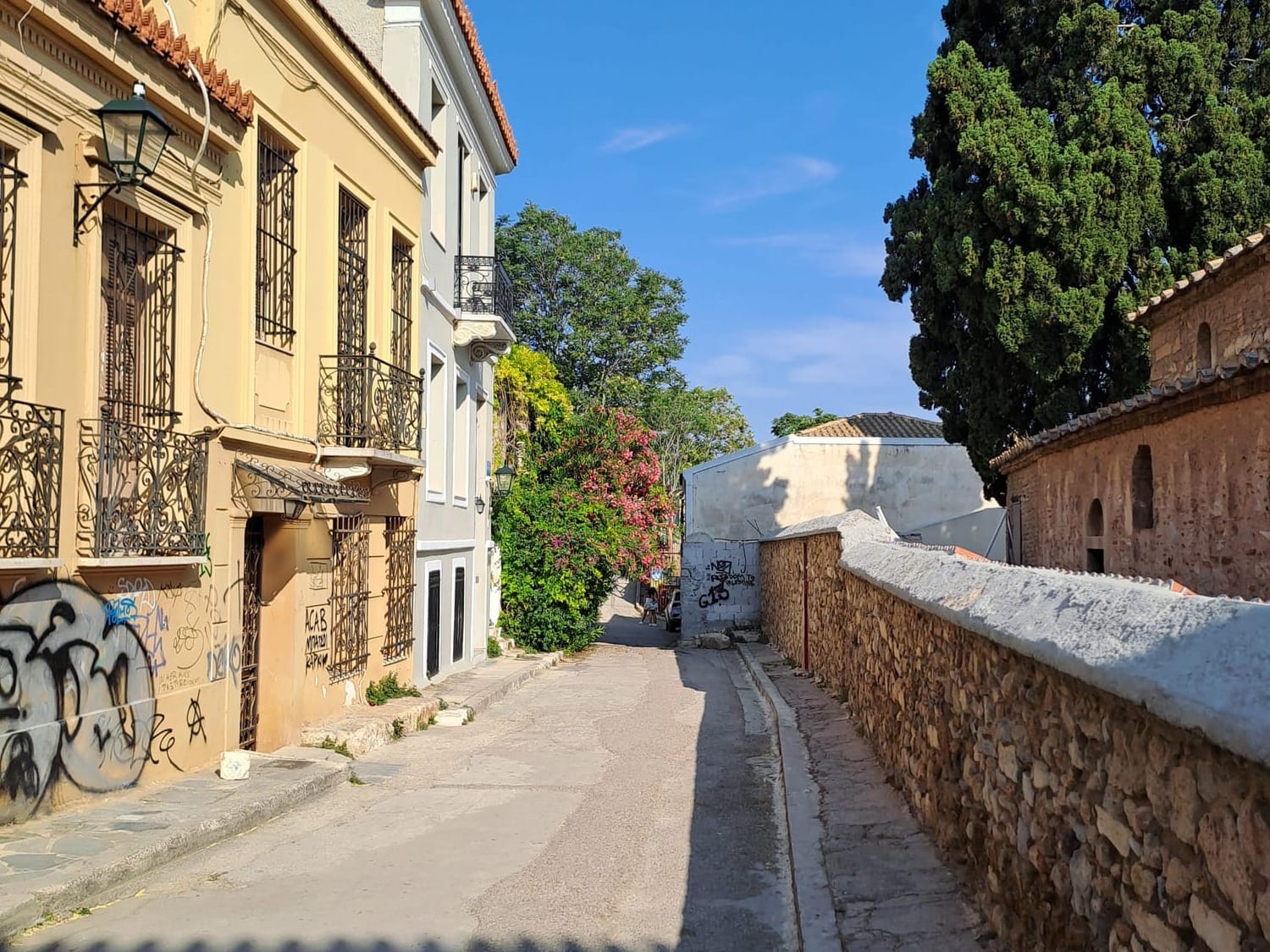
The streets become wider, the buildings more substantial, and the rhythm of the neighbourhood changes. This is the part of Plaka most visitors recognise — but it is worth slowing down here rather than simply passing through.
👀 Look around
Neoclassical façades
Look above the shops and cafés. Plaka retains an unusually rich collection of 19th-century and early 20th-century buildings, many with colourful façades, balconies, shutters and decorative details.
Old and new together
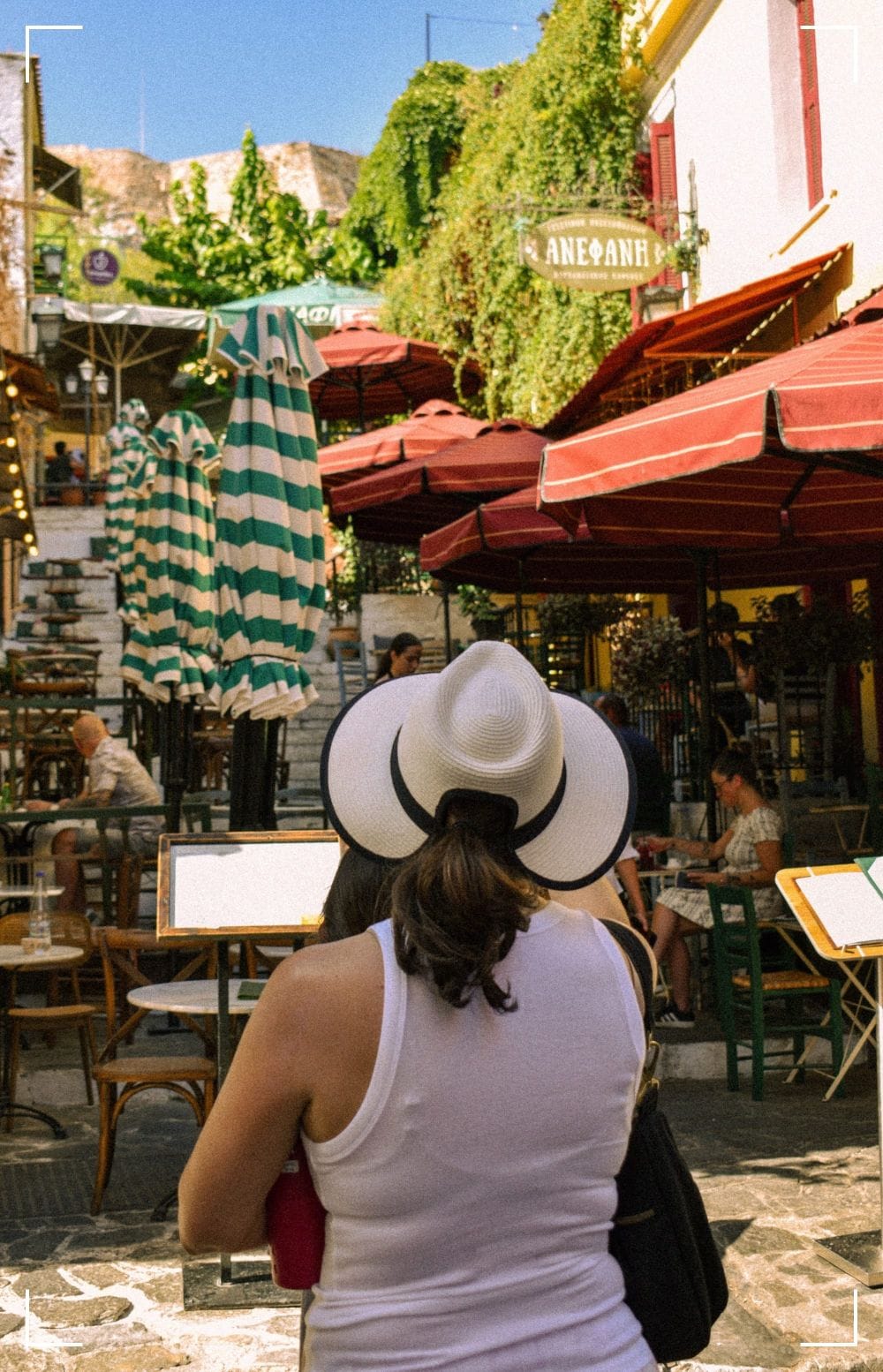
Notice how homes, tavernas, small shops and archaeological remains sit alongside one another. Plaka is not a preserved historical set — it is a living neighbourhood.
The small details
Look for carved doorways, old signs, balconies, courtyards, cats, plants and fragments of older buildings. Some of Plaka's character is found well away from its main attractions.
📖 The neighbourhood that survived Athens' transformation
Plaka occupies the area around the northern and eastern slopes of the Acropolis and is often described as the historic heart of Athens.
Its present appearance, however, is the result of many different periods. Ancient remains sit beneath and beside later buildings, while much of the neighbourhood was shaped during the Ottoman period and transformed again after Athens became the capital of modern Greece in the 19th century.
This mixture is what makes Plaka so compelling.
It isn't one period of Athens preserved in amber. It is several versions of the city layered together.
🚶 Look beyond the main route
The busiest streets are easy to follow, but the quieter side streets are often where Plaka reveals more of its character.
Turn down an unfamiliar lane. Look up at the buildings. Pause at a small square.
You don't need to find a monument every few minutes. Sometimes the neighbourhood itself is the attraction.
← Previous stop | Top | Next stop →
Continue through Plaka's quieter streets towards Adrianou Street, where the neighbourhood opens onto one of its oldest and liveliest commercial routes.
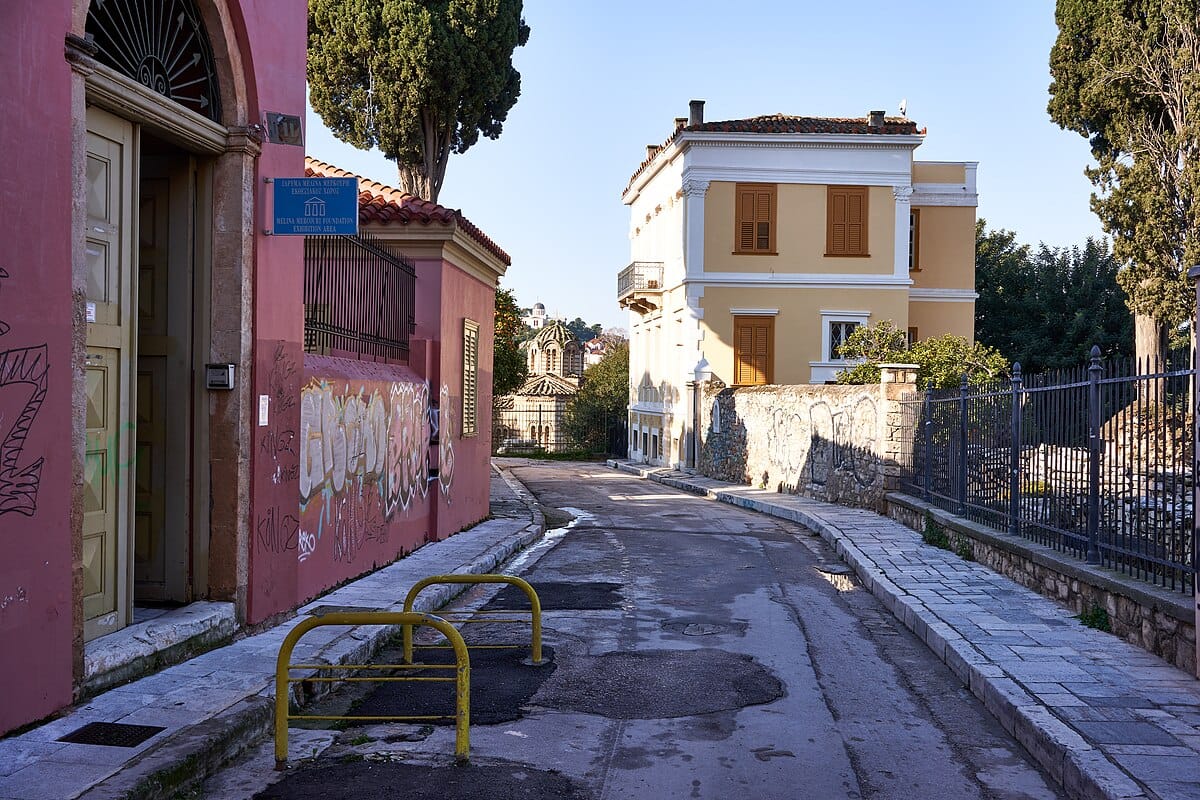
06 — Tripodon Street
Following the footsteps of ancient Athens
Tripodon Street is one of the most fascinating streets in Plaka because its history reaches much further back than the buildings you see today.
Its name comes from the tripods that were awarded to winners of theatrical competitions in ancient Athens. The street once formed part of a route through the Theatre of Dionysus and the surrounding cultural centre of the ancient city.
👀 Look around
The street itself
As you walk along Tripodon, notice its gentle curve and relatively narrow width. Its alignment has remained remarkably close to the ancient route.
The Monument of Lysicrates
Look for the elegant circular monument with its distinctive Corinthian columns. Built in 334 BCE, it was erected by Lysicrates to commemorate his victory in a theatrical competition.
Today it sits almost casually among the houses and cafés of Plaka — a reminder of how deeply ancient history is embedded in the neighbourhood.
The neoclassical houses
The buildings around the monument belong to much later periods. Look for balconies, shutters, painted façades and other details that create the architectural character of modern Plaka.
📖 The world's oldest theatrical street?
Tripodon is sometimes described as one of the oldest streets in the world still in use.
Whether or not you take the claim literally, its remarkable continuity is what makes the street special. The route has connected important parts of Athens for more than two thousand years.
Imagine the same hillside filled with audiences, actors, musicians and visitors making their way towards the Theatre of Dionysus.
Today the setting is quieter, but the street still carries people through the same landscape.
🚶 Slow down here
This is a good place to stop looking for the next attraction and simply observe.
Ancient monument.
19th-century house.
Modern café.
Visitors passing through.
Tripodon is Plaka in miniature: different eras sharing the same street.
← Previous stop | Top | Next stop →
From Tripodon, continue towards Lysikratous Street and the quieter eastern side of Plaka, where the neighbourhood begins to reveal another side of its history.
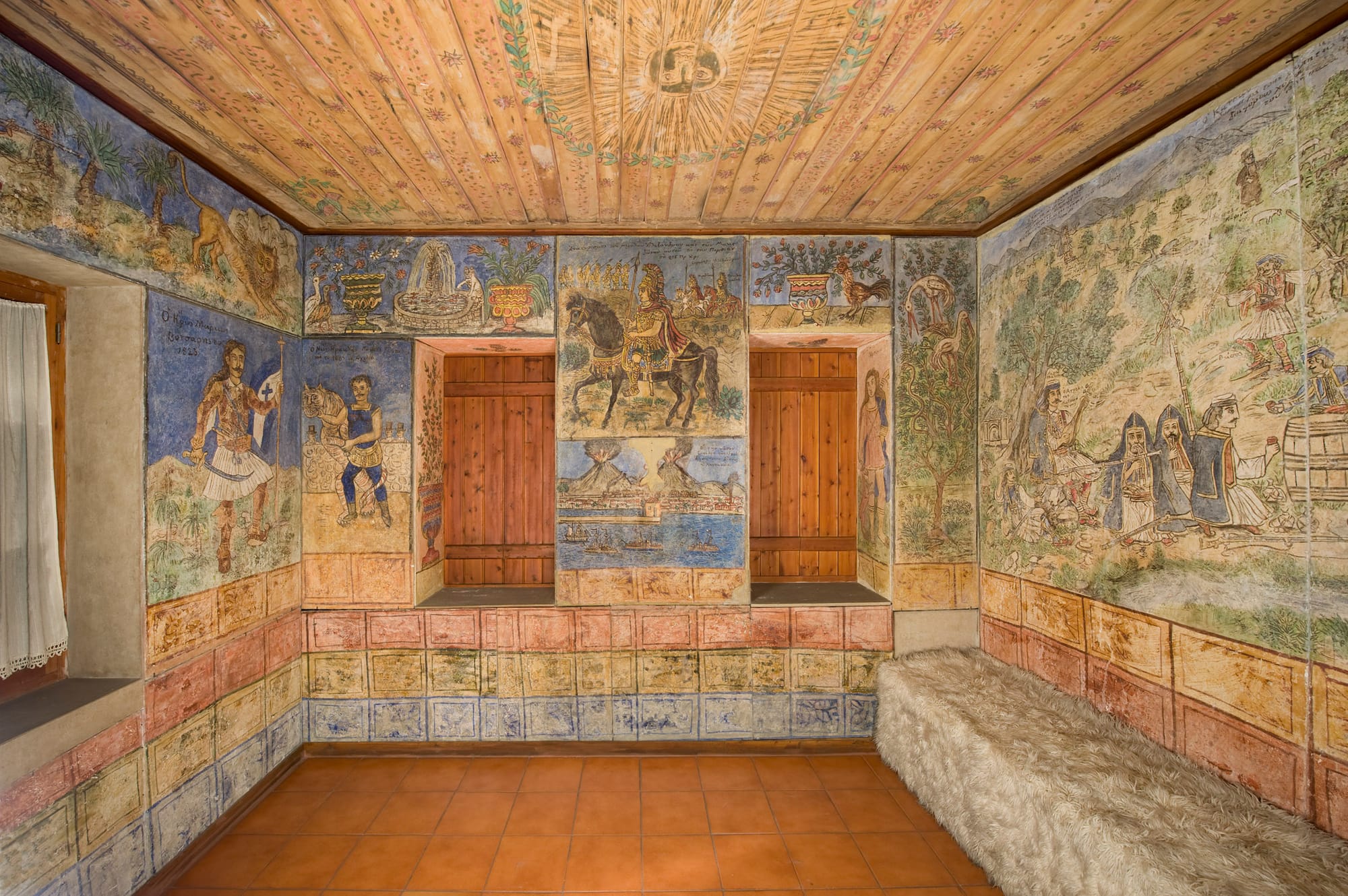
07 — Lysikratous Street
A quieter side of Plaka
Leaving the more familiar routes around Tripodon, Lysikratous Street takes you into a quieter part of Plaka, where residential buildings, small businesses and traces of the ancient city sit comfortably alongside one another.
This is a street to explore at a slower pace. There may be fewer obvious landmarks, but that's precisely the point: Plaka's character often emerges between the monuments.
👀 Look around
The Monument of Lysicrates
The street takes its name from the nearby monument, one of the best-preserved ancient monuments in Plaka. Its circular form and finely carved Corinthian columns make it easy to recognise.
The residential Plaka
Look beyond the main attractions at the buildings around you. Small balconies, colourful façades, shutters and plants give this part of the neighbourhood a distinctly domestic character.
The Acropolis above the rooftops
As you move through the street, the Acropolis periodically appears between buildings and over rooftops. These changing glimpses are part of the experience of walking through Plaka.
📖 From ancient theatre to modern neighbourhood
The story of Lysikratous Street begins with the ancient theatrical tradition of Athens.
The nearby Monument of Lysicrates was erected in 334 BCE to celebrate Lysicrates' victory as a sponsor of a theatrical performance. It was originally part of a larger landscape of monuments celebrating dramatic competitions.
Centuries later, the area became part of the residential neighbourhood we know as Plaka.
The monument survived while the city around it changed almost completely.
That's one of the recurring stories of this walk: the ancient city hasn't disappeared — it has become part of the modern one.
🚶 Keep exploring
This is a good stretch of the walk to simply wander.
Don't worry if you don't encounter another major monument immediately. Look at the proportions of the houses, the small architectural details and the way the streets adapt to the slope of the Acropolis.
← Previous stop | Top | Next stop →
Continue towards Kydathineon Street, where you'll return to one of Plaka's livelier streets and encounter a very different side of the neighbourhood.
08 — Kydathineon Street
The lively heart of Plaka
Kydathineon Street brings you back into one of Plaka's more active areas. Shops, cafés, restaurants and people fill the street, particularly during the day, but beneath the modern activity lies a neighbourhood with a long and complicated history.
This is a good place to experience Plaka as a living neighbourhood rather than an archaeological site.
👀 Look around
The old buildings
Look above the shopfronts for the balconies, shutters and façades of the older houses. Some are carefully restored; others reveal the marks of decades of everyday use.
The street life
Pause for a moment and watch how the street works. Residents, workers, visitors and shopkeepers all share the same relatively small space.
The smaller side streets
Kydathineon is also a good point from which to wander into the surrounding lanes. Some of Plaka's quieter corners are only a few steps away from the busiest streets.
📖 From ancient deme to modern Plaka
The name Kydathineon has ancient roots. Kydathenaion was the name of an ancient deme — one of the local administrative communities of Athens — associated with this area.
The exact appearance and function of the neighbourhood have changed enormously over the centuries, but the name itself offers a connection to the much older city beneath today's Plaka.
This is something you'll encounter repeatedly on this walk:
sometimes the oldest thing in a street isn't a building. It's its name.
🚶 Experience the street
Kydathineon is less about finding one particular monument and more about experiencing the rhythm of Plaka.
Take a moment here. Listen to the conversations, look at the façades and notice how quickly the atmosphere changes when you turn into one of the smaller streets.
← Previous stop | Top | Next stop →
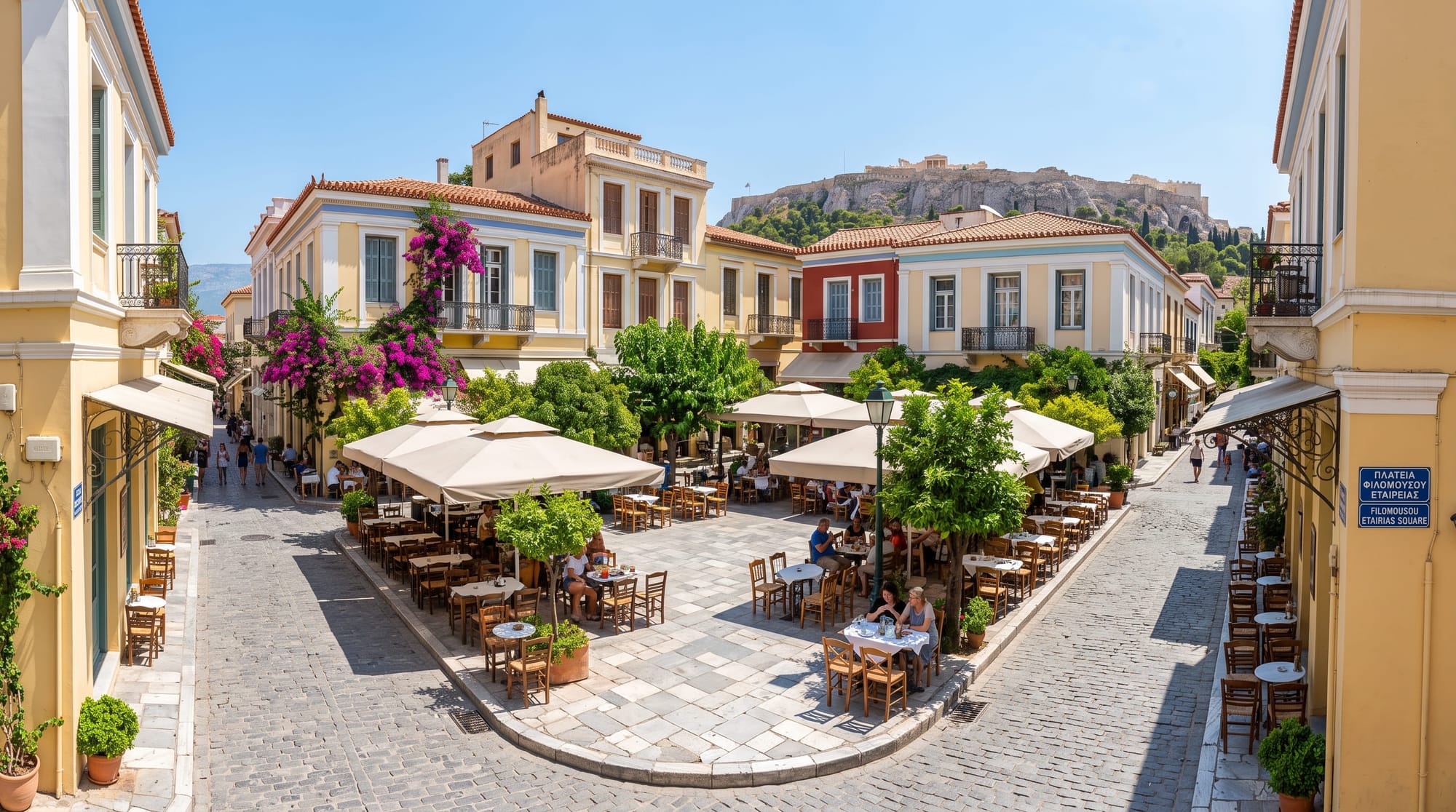
09 — Filomousou Etairias Square
After moving between archaeological sites, quiet lanes and historic buildings, Filomousou Etairias Square brings you back to the everyday life of Plaka.
The square sits at the centre of the neighbourhood, surrounded by cafés, restaurants, small shops and streets that lead in several directions. It is a natural place to pause — and to simply watch Plaka happening around you.
👀 Look around
The square itself
Take a moment to observe how the space is used. Tables spill into the square, people meet and pass through, and the surrounding streets create a lively backdrop.
The buildings around the square
Look above the cafés and shopfronts for the older façades and architectural details that remain part of Plaka's character.
The streets leading away
This is a good place to look at the map and notice how different parts of Plaka connect. The narrow lanes around the square can lead you towards quieter residential corners almost immediately.
📖 A neighbourhood built around community
The name Filomousou Etairias refers to the Society of Friends of the Muses, a cultural organisation founded in Athens in the 19th century.
But today, the square's significance is much more immediate.
It is a place where Plaka's history becomes ordinary again: people sitting together, neighbours passing through, visitors stopping for a drink, and local businesses occupying buildings that have stood here for generations.
After all the monuments and historical references along the walk, this is perhaps the simplest way to understand Plaka as a living neighbourhood.
🚶 Stay for a while
There is no particular landmark you need to rush towards here.
Sit down if you have time. Watch the movement around the square. Listen to the sounds of the neighbourhood.
← Previous stop | Top | Next stop →
Sometimes experiencing a place is simply a matter of staying still long enough to see how people use it.
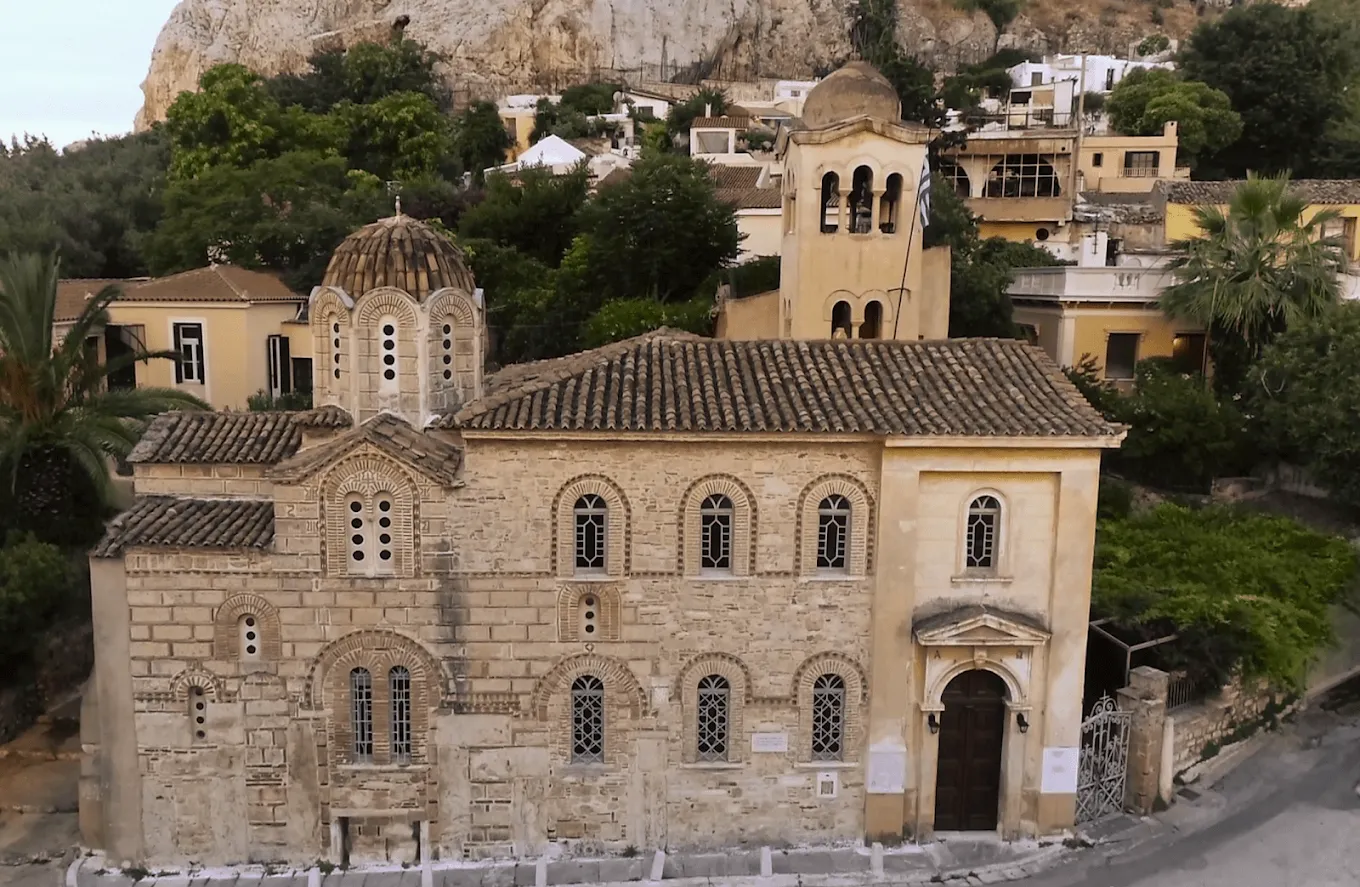
10 — Adrianou Street
A street where old Athens meets everyday life
Adrianou Street runs through the heart of Plaka and is one of the neighbourhood's most recognisable streets. Cafés, tavernas, small shops and souvenir stores fill its ground floors, while older buildings rise above them.
It can feel busy, especially during the day. But look beyond the activity and you'll find a street with a long connection to the life of Athens.
👀 Look around
The old façades
Look above the shopfronts. Balconies, shutters, stonework and neoclassical details reveal the older buildings that make up the street.
The Acropolis
From several points along Adrianou, the Acropolis appears above the rooftops. The relationship between the everyday street below and the ancient monument above is one of the defining images of Plaka.
Monastiraki at the western end
Continue west and Adrianou eventually leads towards Monastiraki Square, connecting the historic neighbourhood with one of central Athens' busiest meeting points.
📖 One of Athens' oldest streets
Adrianou follows a route that has connected the northern side of the Acropolis with the area around the ancient Agora for centuries.
Its name is associated with Emperor Hadrian, whose presence in Athens left a significant mark on the city. Nearby, the Library of Hadrian and the Roman Agora are reminders of the period when Athens continued to flourish long after its Classical Golden Age.
Today, Adrianou is much more commercial, but its role as a street of movement and exchange remains.
People still come here to meet, eat, shop and wander — just as generations before them did in very different forms.
🚶 Look beyond the crowds
Adrianou is one of the places where Plaka can feel most tourist-oriented. Don't let that stop you from looking closely.
The details are often above eye level.
Pause, look at the buildings, and watch how the Acropolis appears and disappears as you move along the street.
← Previous stop | Top | Next stop →
From Adrianou, turn towards the quieter streets around the Roman Agora and Hadrian's Library, where the commercial Plaka gives way to some of Athens' most visible Roman-era remains.
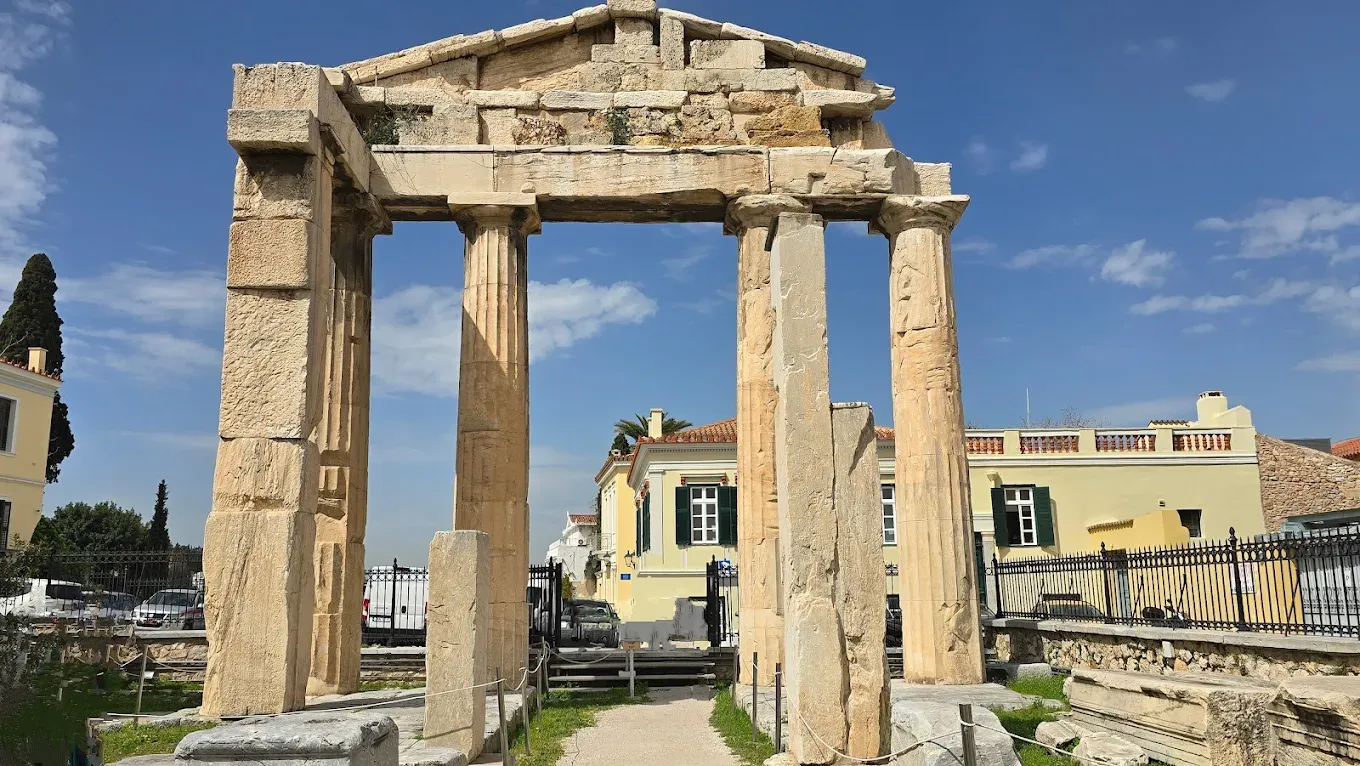
11 — Roman Agora
A marketplace at the edge of ancient Athens
Just beyond the bustle of Adrianou Street, the Roman Agora brings you back into the archaeological landscape of Athens.
The site is easy to miss from the surrounding streets, but once you stop and look through its remains, you can begin to understand how this part of the city functioned almost two thousand years ago.
👀 Look around
The Gate of Athena Archegetis
At the western entrance stands the monumental gateway built in the 1st century BCE. Its four Doric columns are among the most recognisable remains of the site.
The Tower of the Winds
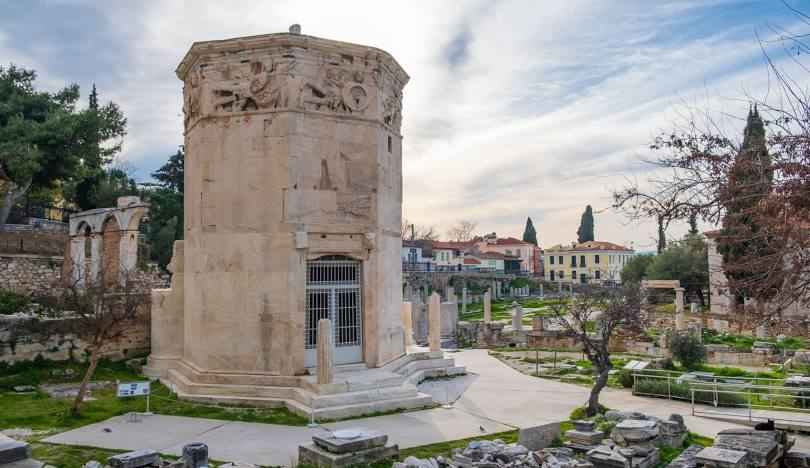
Look towards the eastern side for the remarkable octagonal Tower of the Winds. Built during the Roman period, it functioned as a combination of water clock, sundial and weather indicator.
The surrounding streets
The Agora sits directly within modern Plaka. Look beyond the archaeological enclosure and notice how ancient ruins, modern buildings and busy pedestrian streets occupy the same space.
📖 Athens gets a new centre
The Roman Agora was established during the Roman period as Athens' commercial centre, particularly as the city's existing Ancient Agora became less suited to its changing needs.
The site was funded partly through the patronage of Julius Caesar and Augustus, and construction was completed around the end of the 1st century BCE.
It tells a useful story about Athens: the city didn't stop evolving when its Classical period ended.
New rulers, new buildings and new centres of activity were simply added to the city that was already there.
🔎 Look a little closer
If the site is open when you visit, take time to look at the details of the surviving structures rather than simply photographing the columns.
And if you're continuing the walk without entering, you can still see several of the site's most distinctive elements from the surrounding streets.
← Previous stop | Top | Next stop →
From the Roman Agora, continue towards Tripodon Street, one of the oldest surviving streets in Athens and a particularly interesting place to see how ancient and modern Plaka overlap.
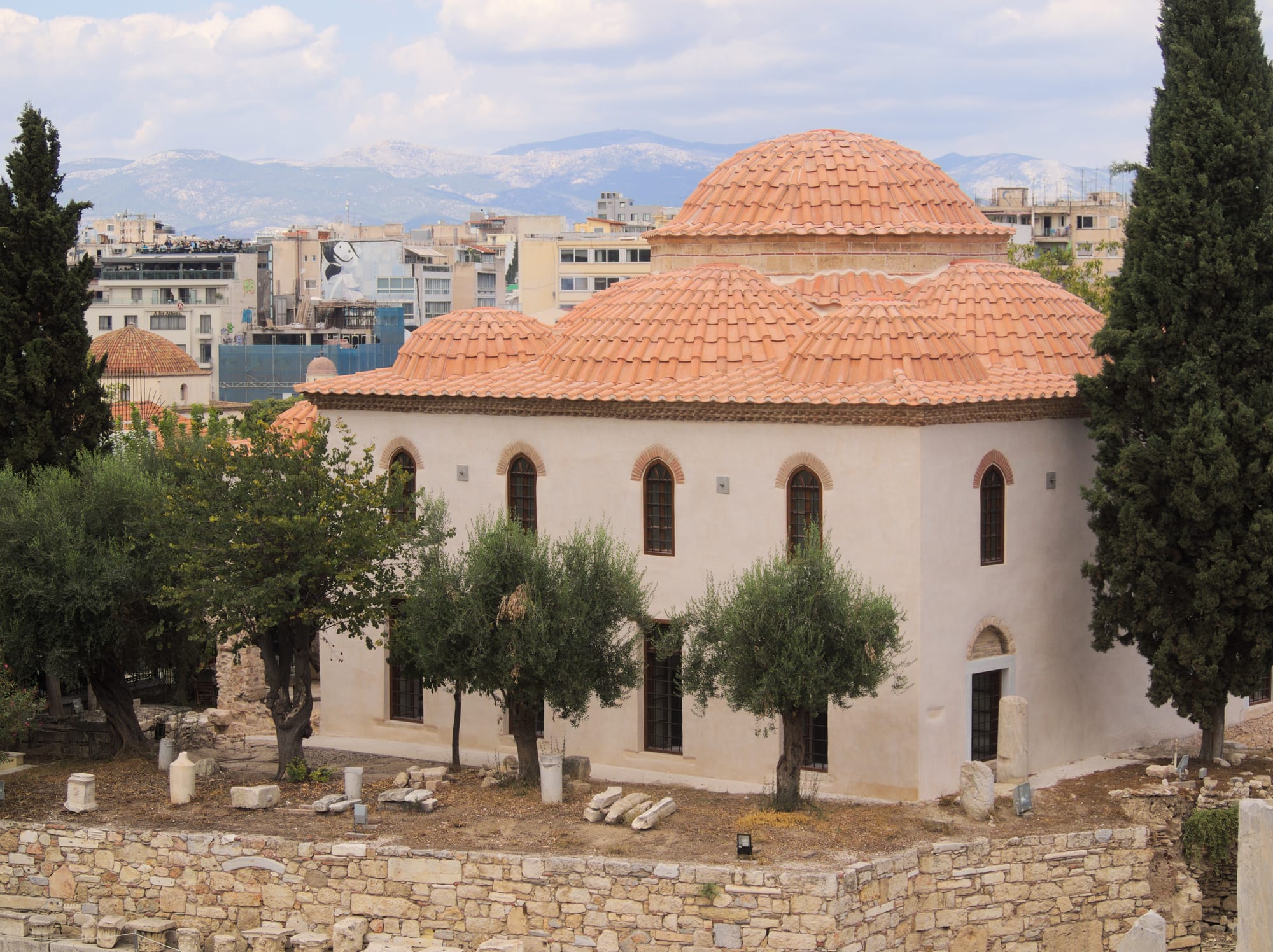
12 — Hadrian's Library
The Roman emperor's gift to Athens
Just off Adrianou Street, the remains of Hadrian's Library mark another dramatic change in the story of Athens.
From the busy streets of modern Plaka, you suddenly encounter the monumental remains of a complex built almost 1,900 years ago — commissioned by the Roman emperor Hadrian during his celebrated relationship with the city.
👀 Look around
The monumental entrance
The impressive façade on the western side was once the main entrance to the complex. Its tall columns would have created a striking arrival point for visitors.
The courtyard
Behind the façade was a large rectangular courtyard surrounded by columns. The complex wasn't simply a library in the modern sense — it was a place for books, study, lectures and intellectual activity.
The contrast with modern Athens
Look around the archaeological site and then back towards Adrianou Street. Ancient Roman architecture, later Byzantine remains and modern Athenian life all occupy the same few metres.
📖 More than a library
Hadrian built the complex around 132 CE, during a period when he invested heavily in Athens and sought to strengthen the city's role as a cultural centre of the Roman world.
Despite its name, the complex served a much broader purpose. It contained rooms for books and study, lecture spaces and a large gardened courtyard.
Hadrian himself was deeply interested in Greek culture and saw Athens as an important centre of learning.
The building therefore tells us something important about Roman Athens:
Rome did not simply rule Athens — its emperors also wanted to become part of the city's intellectual and cultural legacy.
🏛️ Look beyond the ruins
The library has been altered, damaged and reused many times throughout its history. Later structures were built into and around the complex, including a Byzantine church.
This makes the site particularly interesting when viewed as part of the wider walk.
You're not looking at one building from one period. You're looking at centuries of Athens layered on top of one another.
← Previous stop | Top | Next stop →
Leave Hadrian's Library and continue west along Adrianou Street. The archaeological landscape opens up ahead as you approach the Ancient Agora, the civic heart of Classical Athens and the final major historical chapter of the walk.
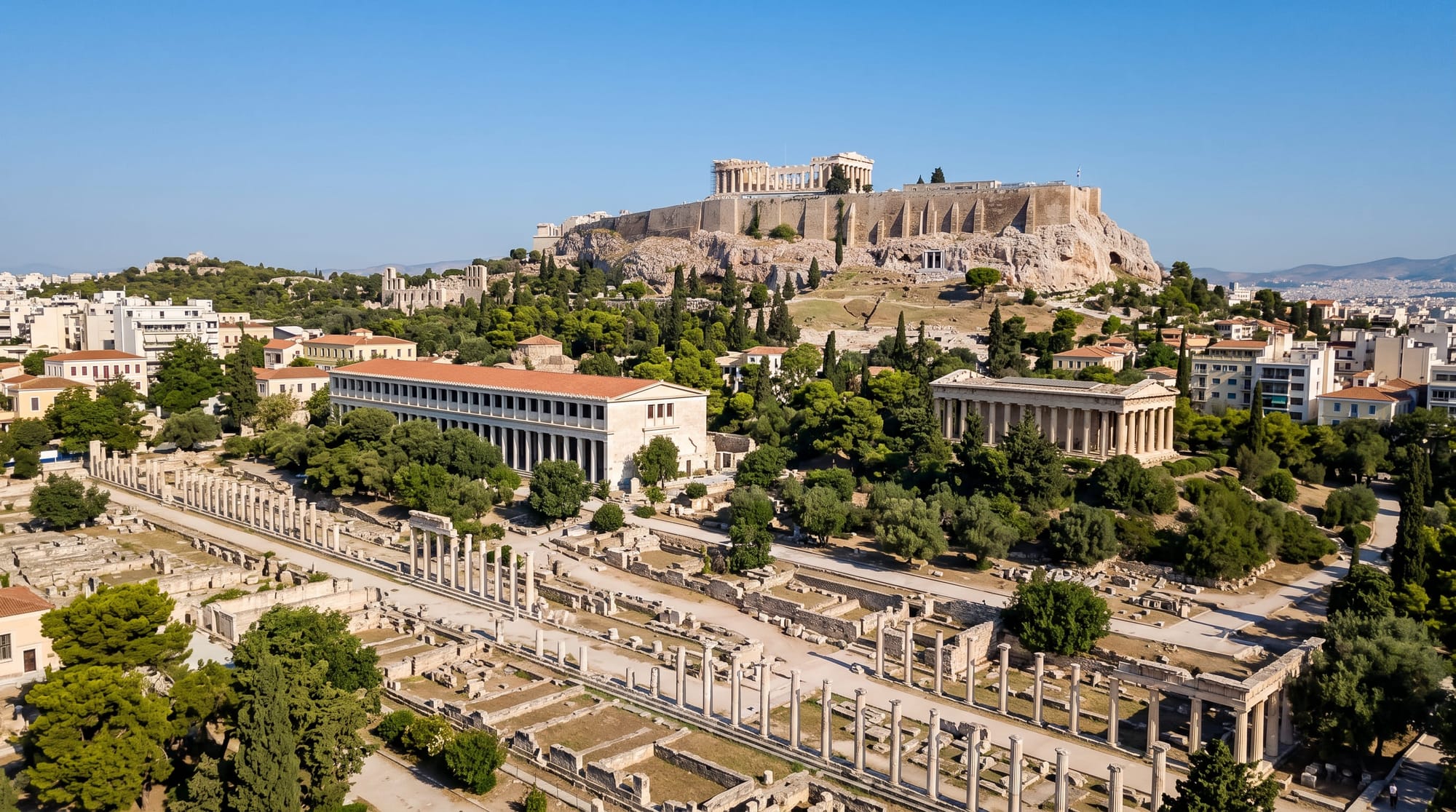
13 — Ancient Agora
Where ancient Athens came to life
From Adrianou Street, the city suddenly opens up.
Below the Acropolis lies the Ancient Agora, one of the most important places in ancient Athens. This was not simply a marketplace. It was where people came to meet, trade, debate, worship and participate in civic life.
After walking through the quieter streets of Plaka, the scale of the Agora gives you a very different sense of the ancient city.
👀 Look around
The Stoa of Attalos
The long, two-storey colonnade on the eastern side of the Agora dominates the site. Originally built in the 2nd century BCE, it has been reconstructed and now houses the Museum of the Ancient Agora.
Temple of Hephaestus
Look towards the hill on the western side of the Agora. The remarkably preserved Temple of Hephaestus has stood here since the 5th century BCE and offers one of the clearest surviving examples of Classical Greek architecture.
The Acropolis behind you
Turn around. From the Agora, the Acropolis rises dramatically above the city. The relationship is significant: the Agora was the civic centre below, while the Acropolis dominated the religious and monumental landscape above.
📖 The heart of democratic Athens
For centuries, the Agora was at the centre of public life.
Athenians came here to buy and sell goods, but also to hear speeches, conduct political business, meet friends, attend religious events and discuss the affairs of the city.
It was also closely connected to the development of Athenian democracy.
Think of it less as an ancient shopping district and more as the public square of an entire civilisation.
People didn't simply pass through the Agora.
They came here to take part in the life of Athens.
🚶 Take in the scale
This is the point in the walk where it's worth slowing down.
Look across the open landscape and imagine the Agora when it was filled with buildings, workshops, temples, politicians, merchants and citizens.
Then look back towards the streets you have just walked through.
Much of modern Plaka grew around and above this ancient landscape.
The city you are exploring today is still organised around the same fundamental geography.
← Previous stop | Top | Next stop →
From the Ancient Agora, you can continue west towards Monastiraki, where ancient Athens gives way to one of the busiest and most contemporary meeting points in the city.
This is where our Plaka walk comes to an end — but not necessarily where your exploration has to stop.
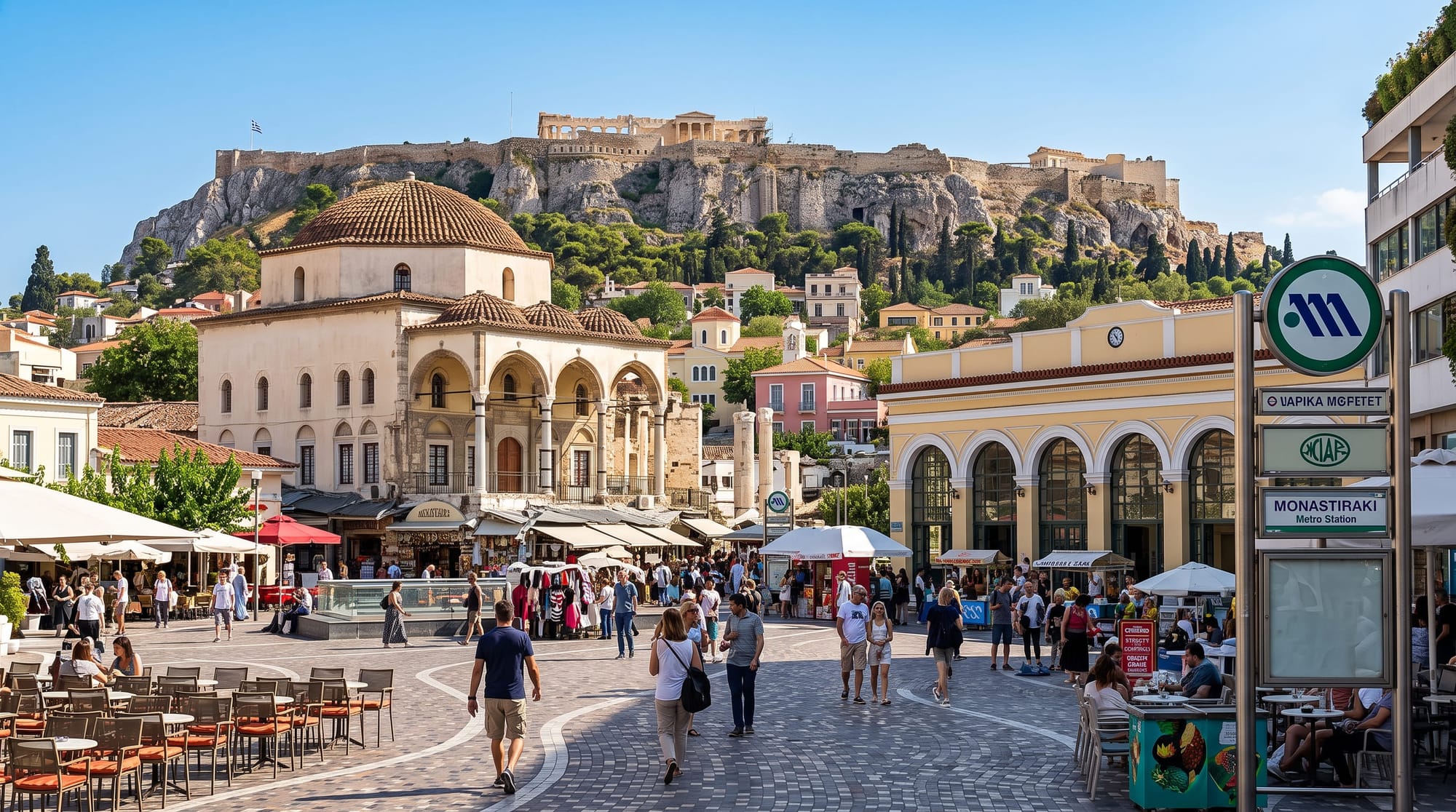
14 — Monastiraki Square
Where the walk meets modern Athens
From the Ancient Agora, continue west and you'll eventually arrive at Monastiraki Square.
The atmosphere changes almost immediately. The quiet archaeological landscape gives way to one of the city's busiest public spaces — metro trains arriving below, vendors and cafés around the square, shoppers moving through the streets, and the Acropolis rising behind it all.
👀 Look around
Tzistarakis Mosque
On the eastern side of the square stands the distinctive Tzistarakis Mosque, built in the 18th century during the Ottoman period. Today it houses part of the Museum of Modern Greek Culture.
Monastiraki Flea Market
Follow the streets around the square and you'll find one of Athens' best-known shopping areas, filled with antiques, vintage objects, souvenirs and everyday goods.
The Acropolis
Before you finish, turn back towards the south. The Acropolis is still there, rising above the dense urban landscape you have just walked through.
📖 From ancient Athens to the city today
It's fitting that the walk ends here.
Over the past few kilometres, you've moved through ancient monuments, Byzantine traces, Cycladic-inspired houses, neoclassical buildings and the living streets of Plaka.
Now all of those layers converge in one place.
Monastiraki is not a preserved historical neighbourhood. It is Athens in motion — ancient ruins beside Ottoman buildings, 19th-century streets beside modern businesses, tourists beside residents, and centuries of history compressed into a few city blocks.
The walk ends here. The city doesn't.
From Monastiraki, you can continue almost anywhere: into Psyrri, towards Syntagma, down to the Ancient Agora, or simply disappear into the surrounding streets.
But if you look back towards the Acropolis one last time, you'll see the same landmark that accompanied you from the beginning.
You have walked through Plaka. Now you know a little more about what lies beneath it.

Acropolis Ticket Tracker
Want to see ticket availability in real time for the Acropolis and the Slopes? Click below and checkout our free calendar utility.
 Chrysanthos Spiliotopoulos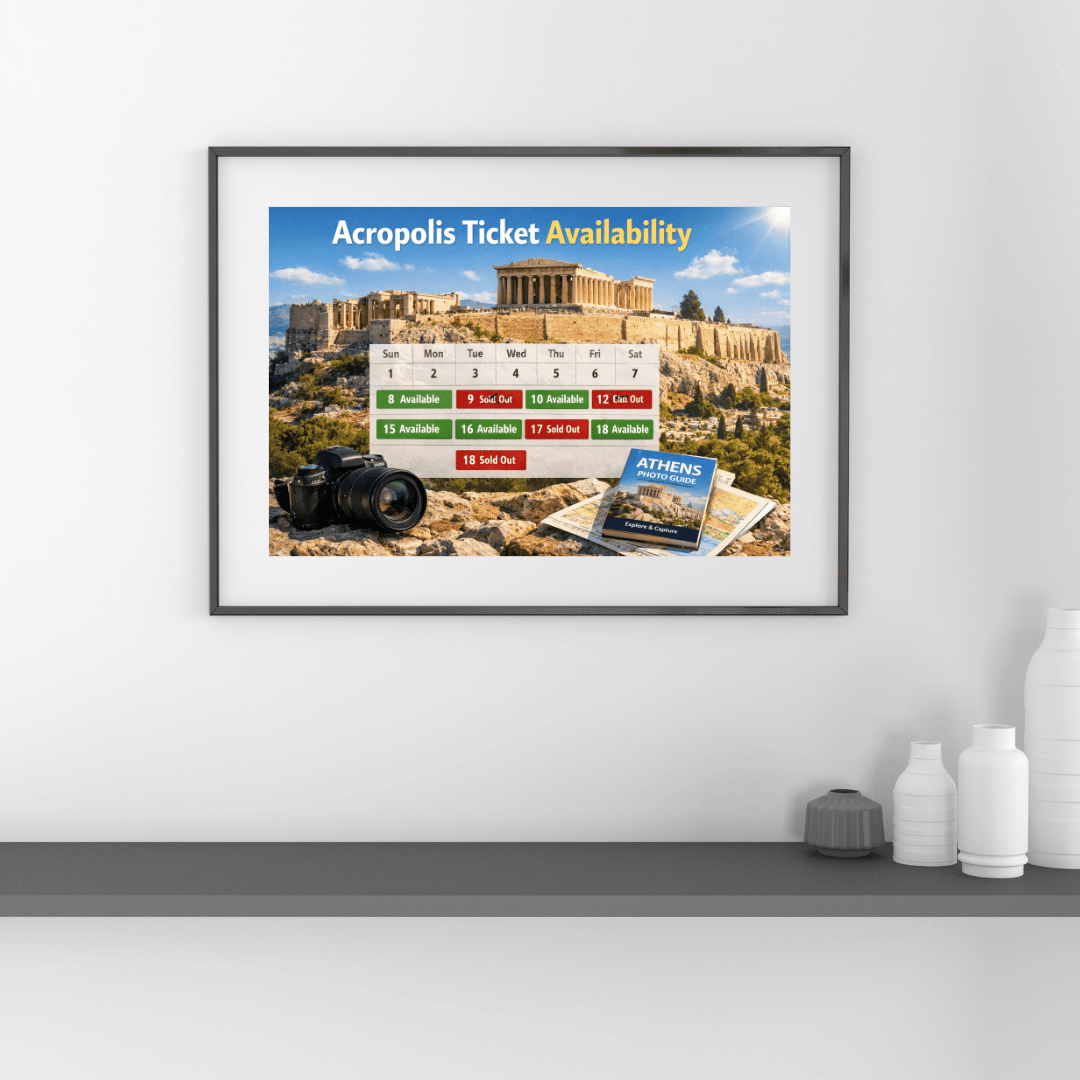
Want to experience Plaka differently?
Click the link below to find out more
 Chrysanthos Spiliotopoulos